Showing posts with label Travel Photos. Show all posts

Sunday, December 7, 2014

A Dream Tour to Kilimanjaro

During my high school time, I read a short story by Ernest Hemingway, The Snows of Kilimanjaro. The story centers on the last memories of a writer who lies on the safari near Mount Kilimanjaro, awaiting his slow death caused by an infected wound. His memory is full of regret that he has not been doing what he should have as a writer. In a dream before he dies, a plane takes him to the top of Kilimanjaro. The story impressed me and forced me to think about the meaning of life. It sowed a seed in my heart to keep on my own way, to be the true myself, and be dare to fulfill my dreams without any regret. Before I graduated, I wrote a to-do-list for myself to celebrate the start of my real life. One item in the list is to climb up Kilimanjaro and view its snow cap on the Equator.


I marked this item in October this year, five years after I wrote it down in the to-do-list. The Seven-day Machame Route on Kilimanjaro was like a dream, interleaved by moments of excitement, pleasure, fantasy, achievement and thankfulness. What I would like to share here are the pieces of memories that I will never forget about.

Into the Forest
After Machame Gate, I stepped into the forest and shook my hand with Kilimanjaro. The mountain welcomed me with towering old trees and sporadic wild flowers. The trees blocked the afternoon sun light, as well as the snow cap high above. For the mountain, I was a child, excited by every single plant which I saw for the first time in my life, breathing the fresh air released by the aged lives. For the mountain, I was also a pilgrim, although uncertain about what would happen in the following days, still walking every step with faith.


Kilimanjaro Impatiens *

Above the Sea of Clouds
It was a bit foggy in the morning. I left the forest behind and climbed up a ridge of heath land. The route was steep and continuously heading up. Looking up to the top of the rocks, a bunch of everlasting flowers was smiling under the sunshine.


Soon after a while, the fog dissipated. I realized that I was already above the sea of clouds. The snow cap of Kibo was clearly showing her face. Taking a deep breath, the pleasant air flowed into my heart. I felt that I was at a higher level of the world, one step closer to the heaven.

A Torch Lily growing above the sea of clouds,
with Mount Meru, the second highest mountain in Tanzania


Saturday, December 28, 2013

Two Days to Touch the Heart of the Inca Culture

It always takes a season to know about a season. But sometimes we just can't afford that. If you are going to Lima, Peru for a business trip but you only have two days (normally a weekend) for spare, you may not be able to go for an Inca trail. However, you still have an opportunity to touch the heart of Inca culture if you plan it well in advance. My two-day-one-night trip to Cusco and Machu Picchu this year may help you on your planning.

Target

I could only leave Lima on the morning of Day 1 and had to come back to Lima on the evening of Day 2. The trip must cover the historic capital of Inca Empire - Cusco, and the "Lost City of the Incas" - Machu Picchu.

Planning

The first thing to plan was the flight. The flying duration between Lima and Cusco was about 1.5 hours. And there were frequent daily flights operated by LAN between the two cities. So it was not difficult for me to book a ticket to bound the trip. Based on my situation in Lima, I decided to arrive at Cusco at 8.25am on Day 1 and depart from Cusco at 5.45pm on Day 2.

When I arrived at Cusco, half of the target was met. Then the following question was: when to visit Machu Picchu? I decided to visit Machu Picchu on the early morning of Day 2, because the sun light was best for photos and it was less crowded. There was a limit of 2,500 visitors per day to Machu Picchu. Although the tickets were seldom sold out, I insisted to purchase the entrance tickets on-line in advance because it saved my time for queuing during the trip. The official website to purchase the entrance tickets to Machu Picchu was:

http://www.machupicchu.gob.pe/

Unfortunately this website was not very user-friendly. Although it provided four languages as displaying options, I could only finish my booking with the default setting - Spanish. When it came to the payment, I had to use a credit card that supports Verified by VISA. I failed to make the payment in IE and Chrome, but finally I made it in Firefox. The price of an adult ticket was about USD 50.

In order to visit Machu Picchu on the early morning of Day 2, I chose to stay near Machu Picchu for the night. Machu Picchu was hidden from the outside world for many years because it was built high on the mountain. As a result, there was only one luxury hotel next to the entrance of Machu Picchu. It was not what I should consider about. At the foot of the mountain there was a village called Aguas Calientes. There were many hotels in this village and most of them were available for booking via Internet agents like Agoda and Booking.com. Since I was going for a business trip, I booked a single room at USD 110.

Between Cusco and Aguas Calientes, there was a long distance, nearly half of which was only accessible by train. There was a direct train between the two places, but the departure time from Cusco was only in the morning and the departure time from Machu Picchu was only in the afternoon, which was not suitable with my schedule above. Fortunately, between Cusco and Aguas Calientes, there was a small town called Ollantaytambo. It was quite common to travel between Cusco and Ollantaytambo by taxi with one-way price of USD 40 in about 2 hours, and the train time table between Ollantaytambo and Aguas Calientes was much more flexible. The train tickets sold very fast. So I had to purchase them on-line at least two weeks in advance. The official website to purchase the train tickets was:

http://www.perurail.com/

This website was more user-friendly than the previous one. One thing to note was that the train station in Ollantaytambo was named Sacred Valley and the train station in Aguas Calientes was named Machu Picchu. The price of the one-way train ticket was about USD 60 and the travelling duration was about 2 hours. I decided to arrive at Aguas Calientes at 8.43pm on Day 1 and depart from Aguas Calientes at 10.55am on Day 2.

The last thing to plan was the ticket of the shuttle bus between Aguas Calientes and Machu Picchu. The tickets were available only in Aguas Calientes. I had to purchase them right after I arrived at Aguas Calientes so that I could take the early morning bus (first bus departed at 5am) up to Machu Picchu before the sunrise. The price of a round-trip bus ticket was about USD 20. And the one-way travel duration was about 30 minutes.

Based on the planning above, I worked out the transportation itinerary as below:

Day 1
Lima 7.05am -> (flight) -> 8.25am Cusco
Cusco 3.30pm -> (taxi in about 2 hours) -> 5.30pm Ollantaytambo
Ollantaytambo 7pm -> (train) -> 8.43pm Aguas Calientes

Day 2
Aguas Calientes 5.30am -> (shuttle bus in about 30 minutes) -> 6am Machu Picchu
Machu Picchu 9am -> (shuttle bus in about 30 minutes) -> 9.30am Aguas Calientes
Aguas Calientes 10.55am -> (train) -> 12.32pm Ollantaytambo
Ollantaytambo 2pm -> (taxi in about 2 hours) -> 4pm Cusco
Cusco 5.45pm -> (flight) -> 7.10pm Lima

Enough time buffer had been allocated in this itinerary.

The Real Trip

I realized this trip in July 2013. During the journey, I almost followed exactly the itinerary. The transit time was more than enough.

A Glance at Cusco

On the morning of Day 1, I reached Cusco. It was a totally different world for people from Lima as me. Lima was at sea level, while Cusco, whose elevation was 3,400 m, was located at the Andes mountain ridge. The sky was high, the weather was cool and the air was thin. The roof of the houses had the same color as the mountains.

Church of the Society of Jesus

Invaded by Spanish Empire in the 16th Century, the land marks of the city gained typical colonial influence. Located at Plaza de Armas, Church of the Society of Jesus was considered as one of the best examples of colonial baroque style in the Americas.

Alley View in Cusco

However, it was not difficult to touch the Inca culture in its historical capital. From the quiet alleys, from the faces of the local people, from the lovely llamas in the streets, the indigenous culture revealed its vitality.

A Statue at the Centre of Plaza de Armas

Wednesday, December 18, 2013

The Eternal City - Rome

Rome, Roma.. The Eternal City.. there is not many people who do not know of this city. A number of friends actually asked for recommendation on what to do in Rome and quite a few who were there gave us pointers too. It seems that this is one of those places that most people have on their must visit list.

Rome is one of the most visit cities in Europe, the capital of the Roman empire, the home of the Pope... the impressive list will go on and on and as we all know 'rome was not built in a day'. It took more than two and half thousand years they say... so you can't really do it in a short few days... But here's what you still can do in 3-4 days.

Best time to visit Rome is when the weather is good - late spring, summer, early autumn.. but obvious the crowd and the cost goes exponentially up. We choose to visit in late November 2013 and took our changes. Flight was cheap, accommodation was cheap.. so why not ;) The trip was still really good but it was raining the the whole time! And when you travel in winter it is dark by 5pm, so hours of sight seeing with daylight is much shorter. The first tip on visiting Rome during rainy season. A good pair of water proof shoes and an umbrella! During peak season.. lots of patience because there will be throngs of people and lots of pre-booking ahead to skip the ticketing lines.

Generally Rome can be divided into 4 'main' areas to visit. Depending on your areas of interest, it can be divided into 4 days for a comfortable visit or combine them for a brisk tour of 2-3 days instead. If you are very interested in history or classic art etc... you could easily spend even more days. Here's a short guide on what you can with 3-4 days.

Rome & Vatican City - Area Overview

Area A - Vatican City & around

This would be the must see for any regular tourist. What some people may not know about the 'Holy See' is that it is an independent state. It is not a part of Rome. In fact, Vatican City is the smallest internationally recognized independent state in the world. How does this effect you? The Roma Pass doesn't work here, you need the buy  a pass intended for the Vatican City or you can just but the tickets online for the museum. St Peter's entrance is free anyways but there is a queue.. so do go early and plan your time well. Also, note the dress code: no shorts, miniskirts or bare shoulders. As we were there in winter, we didn't have this problem. On the weekends look out for time which St Peter's is closed for preparation for Mass.

If you want to see Pope Francis, a nice way is to attend his Sunday Angelus at St. Peter’s Square. You need to go early if you want a place to sit, but otherwise you can watch further away and still see him on the big screen.


We wanted to join a guided tour of the Vatican Museums and Sistine Chapel. Unfortunately if you don't pre-book there was no chance to get an official English tour. There were plenty of other people hawking their own tours but we were not sure of the quality and decided to just give it a miss. If you are interested in taking a tour organised by the museum, do book early with them on their website (link here).

If you like history and renaissance art and such, you could spend easily more than one day just going through the exhibits and the work of many great masters. Leonardo, Michaelangelo, Raphael.. I think all the teenage mutant ninja turtles was there save for Donatello - but I am not too sure.. darn should have taken a guide. Jokes aside, the collection was impressive especially the frescoes. Michelangelo’s frescoes the creation of Adam is perhaps the most well known.. while it was no doubt impressive it was much smaller than I imaged. You practically need to find it amongst a large number of other drawings - it was a strict no photos area with people pushing and swarming all over. Walking while looking up to the ceilings in this condition was not easy.

I'd say spend a whole day here to witness what mankind could so when they set their mind to it. If you are not into this kind of stuff.. 2 - 3 hours will see you brisk walking through everything. At the same time, you could also do Castel Sant'Angelo the fortress and tomb of Emperor Hadrian. Fred said that there is a tunnel from the Vatican for the Pope to escape here if the Vatican City was attacked.

I still say, do it leisurely and take a tour. It is more meaningful if you know the significance of what you are looking at. While it is impressive today, imagine how awe inspiring it was 600 years ago. I guess if I were a peasant and saw for the first time the Vatican City, I would not be able to doubt that God must surely exist to inspire such magnificence. Being an modern day agnostic, I am struck by how much religion can inspire such devotion, fear, love and bring a sense of hope, peace and at the same time cause so much hate, death and destruction of what is perhaps collateral damages for those that got in the way. Rome is incredible in such a way that it offers a brief summary of mankind's religious evolution. The classical Greek gods made way for the classical Roman gods made way for the Christian god - and the Christian church as evolved today as we now know it since what was the beginning of the Catholic faith. How short is our lives compared to what some of these monuments have seen and endured?

Area B - City Landmarks

Around the centre area of the map, you will find the famous landmarks which as mostly made famous because they were in one movie or another. So maybe it is worth watching them before going to Rome :)
Try La Dolce Vita and Roman Holiday.

Everything is walking distance and if you are  fast walker, you can easily cover them in 1/2 day if you want just a touch, snap and go. If you'd like to leisurely walk and shop and eat.. you can also spend a whole day to cover these sights. You will usually see all the usual hot spots highlight on your tourist map, but here are the popular ones once again:

i. Trevi Fountain (Italian: Fontana di Trevi)  


It's the site for many classical films. La Dolce Vita is perhaps was most people know or Roman holiday.
We were told to throw a coin for good luck so that we can return to Rome again someday - but the fountain was so crowded, we just looked around a bit and left. I found this tidbit on Wiki though:

Coins are purportedly meant to be thrown using the right hand over the left shoulder. This was the theme of 1954's Three Coins in the Fountain and the Academy Award-winning song by that name which introduced the picture.

An estimated 3,000 Euros are thrown into the fountain each dayThe money has been used to subsidize a supermarket for Rome's needy; however, there are regular attempts to steal coins from the fountain.

ii. Pantheon


This is the favourite of many history buffs. But if you are not into this kind of thing, you'd be wondering what the buzz is all about! This is a 2000-year-old temple which is now a church, the Pantheon is the best preserved of ancient Roman building. It survived as it was quickly turned into a Church in the 7th century and hence survived to this day. It then became an important burial place for Raphael and some kings. Not too shabby. But look out for the dome. Now that's quite the engineering feat in 120 AD.

iii. Spanish Steps

The 1953 film Roman Holiday made the Spanish Steps famous to audiences. Our host told us that the steps were actually designed by Italians and built by the French - but the Americans started calling it the Spanish steps and the name stuck. The Piazza di Spagna is at the base of the steps and there are some nice frescoes and a poor fountain called Fontana della Barcaccia (Fountain of the ugly Boat), house of the an English poet and lots of high end stores. So if you need to get your fix for some luxury goods, you can start here.

Be prepared for people and more people though... If you want to take good photos, go really really early... otherwise what you get is a loads of people and hardly any view of the steps... :)

Thursday, December 5, 2013

Weekend in San Diego, California

Note from adelaine: Fred's travelling, so he emailed this in instead - excuse his frenchlish (french english) - I have not altered the terms that he is using and if you need clarifications just leave him a comment. Pardon also his ideas on the 'average Americans' too. Haha.. mm.. everyone knows shamu.. reallYyyy?
--------------


If you have the chance to go some days in South California, don’t forget to pass by San Diego !

San Diego is the 7th biggest city in the US with almost 4 Million inhabitant. This is of course a big city but a city which remains easy to enjoy. First of all, what a nice feeling to wake up the morning and not to be worried on the weather forecast…With 25mm rain per year, you have 90% of chance to have sun, blue sky and the beautiful light which goes with it.

Furthermore Californians are very nice and relax. They are respectful of their environment and take care of the quality of their food and beverages.

Being very close to Mexico (40 Km from Tijuana), there is a strong influence from this country in the city. Lots of Mexican restaurant, Tequila Bars… Spanish language is now becoming very usual in south California.

Speaking about foods, some recommendation if you are there :

Try a Mexican restaurant in the old city of San Diego, it is quite typical and traditional. If you prefer Seafood, go to the Fish market restaurant close to the Aircraft Carrier Museum.


As we are in the US, let’s talk about burgers. I am not a « burger fan »  but I have been impressed by the quality of the burgers from the chain « Burger lounge». They prepare succulent « organic burgers », very tasty !

Now let’s talk about sightseeing. San Diego has a lot to offer, so a minimum of 3 Days is required. You can organize your trip in different ways but here are my recommendation :

First Day in Coronado Island and Balboa Park :
 
Coronada Island is located in the middle of the San Diego Bay. The Island is shared between a military Airport for the US Navy operation, and a Small city for rich Americans. This part is a Small Beverly Hills with a beautiful beach not crowded with a wonderful view on Cabrillo National Park. Coronado Hotel is the major attraction of the area. Here was filmed Marilyn Monroe in « Some like it hot ».  you can have a very nice walk along the beach, so don’t miss it !


Balboa Park is located in the center of San Diego. Balboa Park shares its location with the San Diego Zoo, which is considered as one of the best in the world. The park was created for the Panama-California exposition in 1915-16, and is today the place of culture in San Diego. Several Museums and gardens surround the « Casa de Balboa » which is the main monument of the Park. Have relaxing time in Balboa Park , you will not be disappointed !


Monday, November 4, 2013

8 days of Morocco

Morocco, Jul 2013

I made a journey to the Kingdom of Morocco for a wedding with Fred. It gave us a good and valid excuse to travel (again). For me, it was something exotic; first time on the African continent.

You can skip the text too and follow this trip in pictures.


Impressions and travel tips:


First impressions, it was more what you'd imagine of a country in the Middle East than in Africa because of the Arabic culture/background. Morocco has a rich history, so there is plenty to see but preservation works are what you'd expect of a developing nation. What I really liked is its natural wonders. You have the sea, the mountains and the dessert all in one. Though we didn't have enough time to see it all.

What I didn't like about Morocco is consistent with many developing countries around the world, too many people out trying to make a quick buck out of you. People you will offer to bring you around, sell you things, try to over-charge you etc etc and some are very aggressive. The medinas particularly has many kids especially begging and peddling things. If you are a seasoned traveller, you'd know how to walk away from these situations unperturbed. Otherwise, it can spoil your trip. We had someone who tried to rip us of at every city. Puhhh!

Chicken cooked in Tagine
To have a stress-free trip, follow a guided tour. This is one of those countries that where it is best to have a guide from a reputable company to show you around. If you like to travel free and easy, take some trips recommended or organise by the hotel you are staying in and mix and match them. Don't follow just follow someone on the street.

Eat only in places where the prices are stated (we had an experience that they still tried to over-charge us despite the price on the menu- claiming that the servings where different). But don't let this put you off on trying street food though, just be wary of being over charged.


It doesn't mean of course the people of Morocco are not trustworthy, just the few that preys on the tourists really make themselves felt (since you are a tourist). There are 'tourist polices' around but hey, making a living is hard and much harder for countries trying to lift themselves out of poverty. The counter balance of it all is that we also met lots of lovely people. People are warm, friendly and speaks many languages most of the time. Very impressive.

View from a hill
Women at the market
On languages, a treaty between France and Spain regarding Morocco, split it in into a Spanish sphere of influence and a French sphere. It ended in 1956, when both France and Spain recognised Moroccan independence. So you have plenty of people who can speak Spanish around as well a host of Spanish tourist on the 'Spanish side' but most people speaks French all around if case you are wondering which colonial power made the most lasting impressions. The official language is still Moroccan Arabic, so if you speak Arabic you are in luck! However, seems that more and more people are speaking English too as British and American tourist are starting to come in more and at all the tourist places I had no problems with English. Fred did most the other talking in French.

On safety, my feeling is the country is still generally safe. You don't have this feeling that you are in imminent danger and people are not hostile even to tourist.

As a female traveller when going in a Muslim country I always go prepared with a large scarf, cardigans and long pants. Hey, you've gotta be respectful. You'd find that in some cities like Tangier and Tetouan, while it is modern there are hardly any local girls wearing sleeveless shirts. In Casablanca everything got shorter and skimpier. But 'tis better to err on the side of caution when you are not sure how to dress.

A Riad
One another note for female travellers, the tea saloons are mainly for men only, I don't think that they'd chase you away but it is a male domain and you'd be hard pressed to find any females there at all. I heard there are some which are female friendly.. but I don't think it was something I was dying to do- so I didn't make any effort to find one. Seems that the places for local women to mingle is at the Hammam... now that's something I'd like to do! Oh, Mosque too are off-limits to non-Muslims. So do ask before barging in ;) Some place don't let you take pictures.. but these are the 'standard' kind of things. Life also starts late, people and stores start buzzing around 11-ish, people have late dinner and the street crowd is still 'alive' at 10pm. 

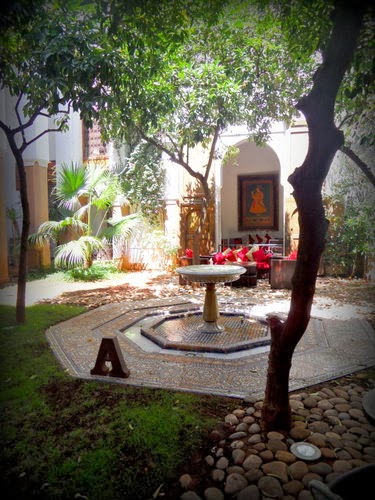
One more tit-bit, the word 'riad' comes from the Arabian term for garden, "ryad". A lot of old houses are being renovated as hotels are called riad when they have a garden in the middle. Those without are called "dar". A stay in a nice riad (or a dar which is usually cheaper) is worth your while but read enough reviews to choose a good one and not an 'imposter'. ;)

So now, let's get to it.


Here's our itinerary:


Tangier - Tetouan - Chefchaouen - Fes - Meknes - Rabat - Casablanca


Tangier

Tangier, Tetoun & Chefchaouen are all a part of the Spanish protectorate, so you could easily see these influences all around.

We flew in to Tangier and rented a car at the airport. If you could drive, this is by far the cheapest option of getting around. Just make sure you rent a GPS too, do not depend on road signs. Other friends who came to the wedding had experiences being stopped by the police in Casablanca to just give you some trouble to get some money. So wear your seat belts and have all your papers (passport, car registration..) in place - don't do anything illegal too. We did not have any problems personally though.

The beach is not the type that I'd swim in (I am a beach snob) but it is pleasant for walks and gives the city an airy feel. There is less tourist and less number of people hassling you which I liked. The city was clean too.

The medina was really rustic, well lived in, rustic - no 'touristic' feeling at all.. you still see people living and working in small little 'stores', making bread, selling stuff.. being just by the coast give it a very nice feeling. One side of the Medina overlooks the ocean and over these ancient walls... lots of development is taking place. Oddly the medina felt undisturbed by what is happening around it.. maybe that's how the Moroccan Medinas managed to survived for centuries.

For the night, Fred has a friend who has a sister who worked in a chain of swanky hotels and got us a room here for free.. connections, this is how things work around here ;) 


Tetouan 

When we visited, I remarked how cleaned it was... the reason we soon found out, the King was there for a visit. I am not sure if it's always like that but it was clean and organised.

Again, you don't get much tourist here and many people spoke Spanish and French. There is also a lot of Andalusian influence still in these parts.

Medina of Tétouan is the UNESCO list and most probably has not changed much in the last few hundred years. The royal palace in Tétouan is situated just outside and by one of the entrances to the Medina. The city is easy to discover by foot, with nice public squares and old buildings.  It is a really pleasant place to walk around. Again the city feels more like something you live in rather than something to wow tourist. So depending on if you travel for 'wows' to for the want to experiencing how the locals live, you level of excitement over this city will differ.


Chefchaouen

Now this place has a 'wow' factor.  First of all, it is in different shades of blue and Chefchaouen is situated in the Rif Mountains giving it a surreal landscape suited for picture taking.

We made only a day trip here but it was good enough to get some good pictures and off we go to Fez. Maybe we are not at the peak season because it was not too packed and we like the easy pace of the place. But a large number of hotels and souvenir shops seem to indicate that many tourist do come.By the way, the Chefchaouen region is supposed to be one of the main producers of cannabis in Morocco. I didn't.